
The Cable Is the Easy Part
Brussels Bets €2.3 Billion on a Corridor It Cannot Defend

On January 8, 2026, Azerbaijan’s president Ilham Aliyev cut the ribbon on the largest wind farm in the Caucasus. The 240 megawatt Khizi-Absheron plant, thirty-seven turbines arrayed across two districts north of Baku, was developed by Saudi Arabia’s ACWA Power for roughly $340 million. The main contractor, the firm that put the steel in the ground, was PowerChina Huadong Engineering. The ribbon was Azerbaijani. The capital was Saudi. The execution was Chinese.
This is the pattern the Trans-Caspian Green Energy Corridor is being built on. Three presidents announced it at COP29 in Baku — Azerbaijan, Kazakhstan, Uzbekistan — and the European Union has reciprocated with Project of Mutual Interest status, Ten-Year Network Development Plan inclusion, World Bank concessional financing, and a reported funding intention of approximately €2.3 billion for the Black Sea cable that would carry the electrons westward. By 2032, if the timetable holds, renewable power generated on the Kazakh steppe and in the Uzbek desert would cross the Caspian to Azerbaijan, traverse Georgia overland, and arrive at Constanța, Romania, via 1,195 kilometers of submarine cable beneath the Black Sea.
I argue that the cable will get built. The engineering is realistic, the financing is credible at the cable level, and the EU’s commitment, while ambiguous in instrument, is substantial in headline scale. What will fail is the EU’s ability to determine what kind of corridor gets built. The Caspian three are reproducing the petrostate transit logic they learned with oil and gas, and the upstream of the corridor — the equipment supplied, the rents extracted, the political dependencies created — is being shaped by Chinese commercial centrality and a Russian counter-portfolio that Brussels has neither the conditionality instruments nor the institutional architecture to defend against.
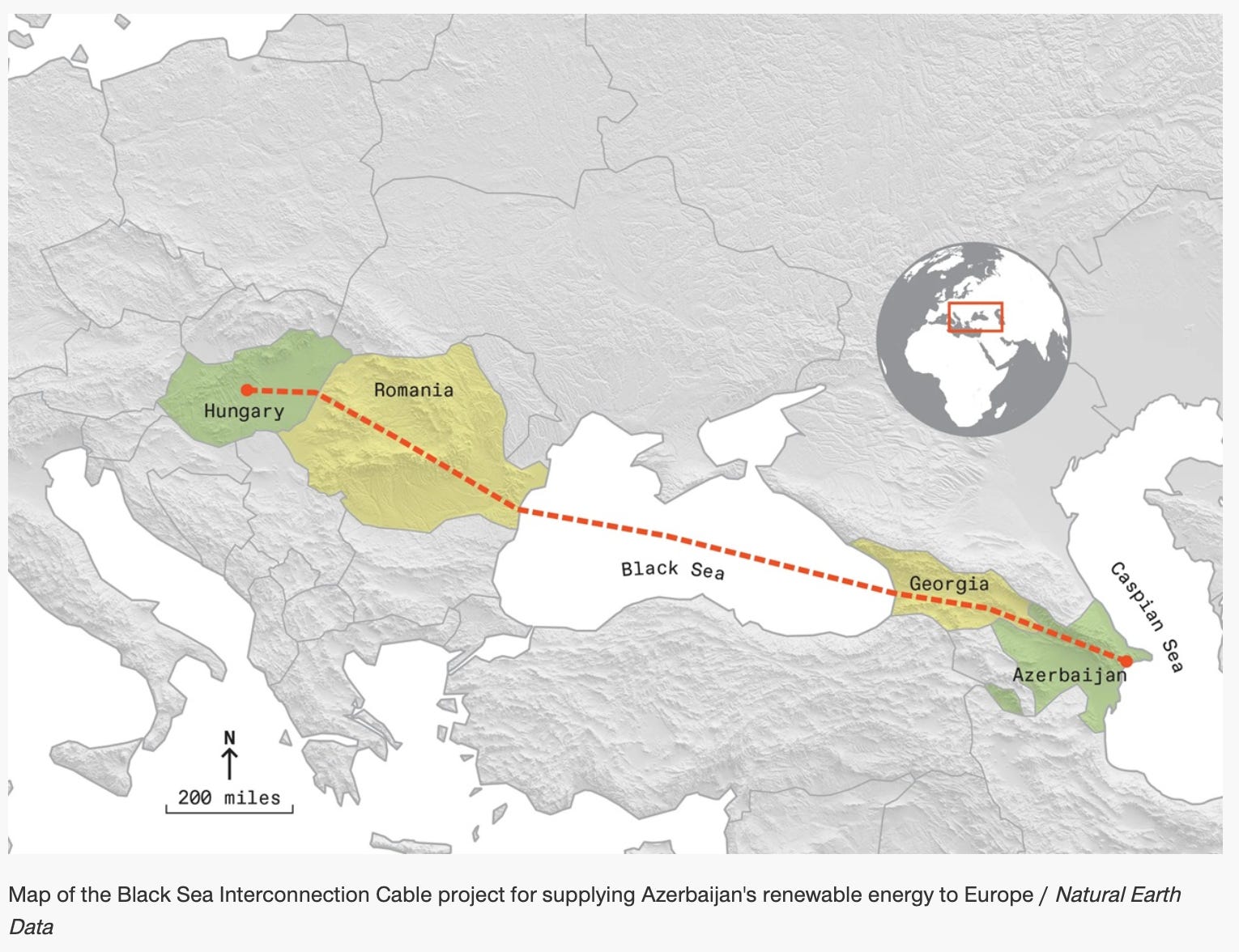
Source: Caspian News (https://caspiannews.com/news-detail/black-sea-interconnection-cable-gains-pmi-status-in-new-eu-energy-package-2025-12-3-0/)
The cable is the easy part
The Black Sea Submarine Cable is technically and economically realistic. CESI, the Milan engineering consultancy running the feasibility study, has confirmed it can be built. The phase-one configuration is a ±500 kilovolt high-voltage direct current bipolar link, capable of moving between one and 1.5 gigawatts across 1,195 kilometers of seabed, much of it deeper than 2,000 meters. The total cost band, €3.1 to €3.7 billion, breaks down to roughly €2.6 to €3.1 million per kilometer. That is squarely within the industry norm of €2 to €5 million per kilometer for subsea HVDC and is closely aligned with comparable European interconnectors.
NordLink, the 623-kilometer link between Norway and Germany, cost €1.5 to €2 billion at €2.4 to €3.2 million per kilometer. Viking Link, the 765-kilometer cable between the United Kingdom and Denmark, cost roughly £1.7 billion at about €2.6 million per kilometer. Black Sea would be longer and cross deeper water, and it is being procured into a more complex political environment, but it is not aspirational at its planning cost. Anyone arguing the cable is too expensive to build is arguing against an engineering verdict the EU and CESI have already settled.
That matters because it removes a particular kind of skepticism from the table. The corridor’s risk does not live at the cable. It lives upstream — in the generation that has to be available, the equipment that gets installed to produce it, the political environment that determines whose equipment counts, and the institutional architecture in Brussels that would, in a coherent cleantech foreign policy, condition all of the above on something. None of that machinery currently exists.
What Brussels actually committed
For most of the corridor’s life, the question among policy people in Brussels was whether the EU was committing anything beyond rhetoric. The Project of Mutual Interest grant in December 2025 unlocked regulatory pathways and access to EU funding instruments, but it did not by itself put euros on the table. Inclusion of the Black Sea Energy Phase 1 and Phase 2 projects in ENTSO-E’s TYNDP 2026 portfolio activates a cost-benefit analysis due at the end of this year. The World Bank’s $35 million for the first phase of the ESPIRE program, with a potential envelope of $500 million across three phases, is concessional preparatory money — feasibility studies, environmental assessments, institutional capacity-building — rather than construction capital.
The number that does the work, when it gets cited, is €2.3 billion. The European Commission has reportedly indicated an intention to provide that much for the project. It is a meaningful figure. It is also, by the EU’s own characterization in adjacent reporting, not yet guaranteed and likely insufficient to complete the cable. The phrase “more will be needed” attaches to the €2.3 billion in the same paragraph that announced it.
This is not symbolic politics. €2.3 billion of intended financing is roughly 62 to 74 percent of the cable’s total estimated cost. It is, however, ambiguous politics. The instrument that would carry the money is unspecified. The conditionality, if any, attached to the disbursement is unspecified. The schedule and the trigger conditions are unspecified. The procurement requirements that would shape who builds what are unspecified. PMI status confers regulatory privilege; ENTSO-E inclusion confers planning legitimacy; ESPIRE confers preparatory funding; the €2.3 billion intention confers a headline number. What the EU has not done is articulate, in any document I can find, what it expects to receive in exchange.
A rough scale-check: Uzbekistan’s announced 27 gigawatt renewable target by 2030 is roughly three-quarters of the entire installed electrical generating capacity of New York State. As of October 2025, Uzbekistan had built 4.7 gigawatts of wind and solar, about seventeen percent of target, and domestic electricity demand is projected to roughly double over the same window. The fraction of all that capacity actually available for export is the question CESI’s full feasibility study, expected in early 2027, will try to answer. Brussels has so far not asked the question publicly.
https://caspiannews.com/news-detail/black-sea-interconnection-cable-gains-pmi-status-in-new-eu-energy-package-2025-12-3-0/
The capture, in three pieces
Capture, in the sense that I use it, means the project will be built but politically reconfigured — Brussels buying electrons through assets shaped by other actors’ commercial and strategic interests, with limited European control over what those assets look like. (Reminds you of anything?)
The pattern shows up in three places.
First, Chinese centrality is on a clear trajectory and is already concrete at the flagship asset. PowerChina Huadong is the main contractor at Khizi-Absheron, not a peripheral supplier. PowerChina Resources, China Datang Overseas Investment, and China Energy Overseas Investment are formal partners with SOCAR Green and the Caspian Breeze Consortium of ACWA Power and Masdar in the memorandum covering two gigawatts of offshore wind in Azerbaijan’s sector of the Caspian. The aggregate share of Chinese equipment in the corridor’s planned generation cannot yet be quantified from public sourcing — the right claim is trajectory, not established dominance — but the trajectory is what matters when conditionality instruments do not exist to deflect it.
Second, Russia’s counter-positioning has shifted from gas to Rosatom, and it is concrete. Rosatom built its first wind plant abroad in Kyrgyzstan, a 110 megawatt installation, and announced a $1.5 billion package of additional renewable investments there including a 400 megawatt hydroelectric plant. Rosatom signed nuclear cooperation deals with Uzbekistan in June 2025 and is constructing Kazakhstan’s first nuclear plant. The instrument is commercial diplomacy with infrastructure attached, and it competes for the same Caspian elite attention and capital that the corridor needs.
Third, and least appreciated, China and Russia are competing in the region rather than aligning. China National Nuclear Corporation is offering 2.4 gigawatts of nuclear capacity for $5.47 billion, undercutting Rosatom on cost. Uzbekistan, three months after signing with Rosatom in June 2025, signed a contingency nuclear arrangement with CNNC in September 2025. The “Russian challenge” and the “Chinese capture” are not a single coalition pressing the corridor; they are two actors with overlapping commercial reach who are partially crowding each other out. There is an opening there for Brussels but no reassurance. The conflict with Russia mean that Chinese centrality grows (as Russia is being out-competed by China) and the EU lacks the instruments to constrain either in the region.
https://www.pexels.com/photo/abstract-metal-construction-in-anaklia-samegrelo-georgia-16707620/
The Caspian-side problem
There is a sub-cable across the Caspian. There has to be: Kazakh and Uzbek electrons cannot reach Anaklia without crossing water. In April 2025, AzerTelecom and Kazakhtelecom awarded a supervision services contract for a 380-kilometer subsea cable from Aktau to Sumqayit, a project they expect to finish by the end of this year. That cable carries 400 terabits per second of data. It is fiber-optic. It has nothing to do with electricity.
The Caspian energy sub-cable, the one the corridor’s premise depends on, exists in ministerial statements, signed memoranda, and the headline of CESI’s feasibility framework. Specifications, financing, construction timetable, and procurement structure are not yet public in the way the Black Sea segment’s are. This is the upstream choke point of the entire corridor, and it is the part the optimistic case treats as solved.
A second scale-check makes the underlying gap concrete. Azerbaijan generated approximately 49 million kilowatt-hours of wind power in 2024 — enough to power 4,500 average American homes for a year, a fraction of the output of one mid-sized US wind farm. The corridor’s first-phase one-gigawatt cable would need roughly the output of one American nuclear reactor flowing through it, sustained, around the clock. Khizi-Absheron’s 240 megawatts and Bilasuvar’s 445 megawatts under construction are real progress, but the math between operating Caspian generation today and the export volume the cable’s economic case requires is an order of magnitude. The Caspian sub-cable would carry it; we do not yet know what the Caspian sub-cable is.
The corridor will most likely be built. The cable will get laid, the consortium will hold together, the electrons will flow westward in some volume by 2034 or shortly after. What will not exist by then is a coherent EU answer to the question of what cleantech foreign policy is supposed to be. Conditional electrons — renewable partnerships shaped the way the EU already shapes trade preferences, contingent on alignment, governance, and equipment-supply requirements — would require an institutional architecture that Brussels has not yet built. DG ENER owns energy policy but not foreign affairs. The European External Action Service owns foreign policy but not energy or industrial policy. The Climate Commissioner has the agenda but not the instruments. Member-state coalitions on this corridor — Romania, Hungary — own the political will but not the coordination. The €2.3 billion is being committed before any of these bodies has been assigned the brief.
If you work on EU energy diplomacy, on Caspian energy infrastructure, or on the Brussels architecture of Global Gateway and REPowerEU, I’d value your read on which institution you think should hold this brief, and what conditionality instruments you think are realistically available at this stage of the project. The cable is the easy part.
References
1. Black Sea Submarine Cable Project, European Commission International Partnerships, accessed May 2026.
2. CESI feasibility study (Phase 1 conclusions), reported in IEEE Spectrum, “Black Sea Cable to Boost EU Energy Security with Clean Power” and “Azerbaijan’s $3.8B Green Energy Plan to Power Europe.”
3. World Bank, “World Bank Approves $35 Million Investment for Black Sea Submarine Cable Project Preparatory Activities,” May 21, 2024.
4. European Commission inclusion of Black Sea Submarine Cable on PMI list, December 2025; Georgian State Electrosystem and News.az coverage.
5. EU funding intention €2.3 billion: QazaqGreen, “EU plans to allocate 2.3 billion euros for Black Sea green cable project”; IEEE Spectrum (caveat that funding is not guaranteed).
6. Khizi-Absheron Wind Power Plant inauguration: Renewables Now, The Astana Times, APA, January 2026.
7. PowerChina Huadong as main contractor: APA, Medianews.az, January 2026.
8. Caspian Breeze Consortium (ACWA, Masdar, SOCAR Green) cooperation with PowerChina, China Datang, China Energy Overseas Investment: Offshore Wind, Saur Energy.
9. Trans-Caspian fiber-optic cable, distinct from energy sub-cable: AzerTelecom-Kazakhtelecom, Submarine Networks, The Astana Times.
10. Rosatom in Central Asia: Caspian Policy Center, “Rosatom in Central Asia”; Eurasianet, “Russia pressing Central Asian states to embrace nuclear power”; RFE/RL, “How Does Central Asia Fit Into Russia’s Nuclear Energy Diplomacy?”
11. Uzbekistan-CNNC contingency nuclear deal: Central Asia-Caucasus Analyst, “China Reshapes Central Asia’s Russia-Dominated Nuclear Landscape”; Eurasianet.
12. Uzbekistan installed wind+solar 4.7 GW (October 2025) and 27 GW 2030 target: Enerdata; IEA, Solar Energy Policy in Uzbekistan: A Roadmap.
13. Azerbaijan installed renewable capacity (1,829 MW end-2025) and 2024 generation: Caspian News, Azerbaijan Ministry of Energy, Mordor Intelligence.
14. Black Sea cable JV (Transelectrica, GSE, AzerEnerji, MVM) headquartered in Romania: Balkan Green Energy News, RFE/RL, Romania Insider.
15. NordLink and Viking Link cost benchmarks: Wikipedia (NordLink, Viking Link); ABB white paper; National Grid.
16. ENTSO-E TYNDP 2026 portfolio inclusion: Caliber.Az, BlackSea-Caspia.
Notes on sources and contested figures
i. The €2.3 billion EU funding intention is reported across QazaqGreen (Tier 3) and IEEE Spectrum (Tier 2), with the latter explicitly noting the funding is not guaranteed and that more will be needed. The European Commission’s own International Partnerships page on the Black Sea cable does not commit to a public euro figure. The article uses €2.3 billion with the attribution and caveat consistent with this sourcing.
ii. Phase-one cable capacity is reported variously as 1.0 GW (most EU and Submarine Networks references), 1.3 GW (CESI configuration cited by IEEE Spectrum), and 1.5 GW (CESI engineering ceiling cited by Belfer Center). The article uses 1 GW as the conservative phase-one figure consistent with the launcher’s “prefer the conservative on disagreement” rule.
iii. Aggregate Chinese equipment share in the corridor’s planned generation cannot be quantified from current public sourcing. The article frames Chinese centrality as a documented trajectory at named projects (Khizi-Absheron main contractor; 2 GW offshore wind MoU partner) rather than as established system-wide dominance.
iv. Direct Russian operational interference with the corridor (cable threats, EAEU pressure on vendor selection, sanctions-evasion enforcement) is not surfaced in current sourcing. The article treats Russian counter-positioning as the documented Rosatom commercial portfolio in Kyrgyzstan, Uzbekistan, and Kazakhstan, rather than as operational sabotage of the corridor itself.
v. Corridor launch dates vary by source: 2032 announced by Azerbaijan’s Orkhan Zeynalov; 2040 reported by Interfax for “full launch”; CESI implementation estimate of three to four years from final investment decision. The article uses “by 2034 or shortly after” as a conservative central estimate consistent with EU implementation norms.